Having cancer treatment in a day oncology unit: what to expect, and what to ask before you start
If you’ve just been told you need cancer treatment, there’s a lot to take in. Your medical oncologist or haematologist will talk you through the treatment, which may include weeks of oncology infusions to aid in your recovery. Alongside that, there are practical things you’re entitled to ask about, and the answers can make the months ahead easier to plan around: where you’ll have treatment, who can be there with you, and what it will cost. This guide explains how day oncology works, what a treatment day looks like, and the questions to ask before your first appointment. It’s general information, not a substitute for advice from your own treating team.
Key takeaways
- Many cancer treatments, including chemotherapy and immunotherapy, are given in a day oncology unit, so you go home the same day.
- You’re entitled to ask your medical oncologist or haematologist which hospitals they treat at, and to factor that into your plans.
- Ask for a written estimate of costs before you start, covering the hospital, your specialist and your medicines.
- At Adeney Private Hospital in Kew, eligible Medibank and Bupa members can have zero out-of-pocket hospital costs for oncology treatment, with some exceptions.
What is a day oncology unit?
A day oncology unit is the part of a hospital where you receive cancer treatment and go home the same day. Most treatments are given through a drip into a vein, or through a port or PICC line that provides longer term access throughout your treatment. They can include chemotherapy, immunotherapy, targeted therapies and supportive treatments such as fluids or blood transfusions. Some treatments are given intravesically, meaning that the treatment is given directly into the bladder via a urinary catheter. Your medical oncologist or haematologist decides what you’ll have and how often.
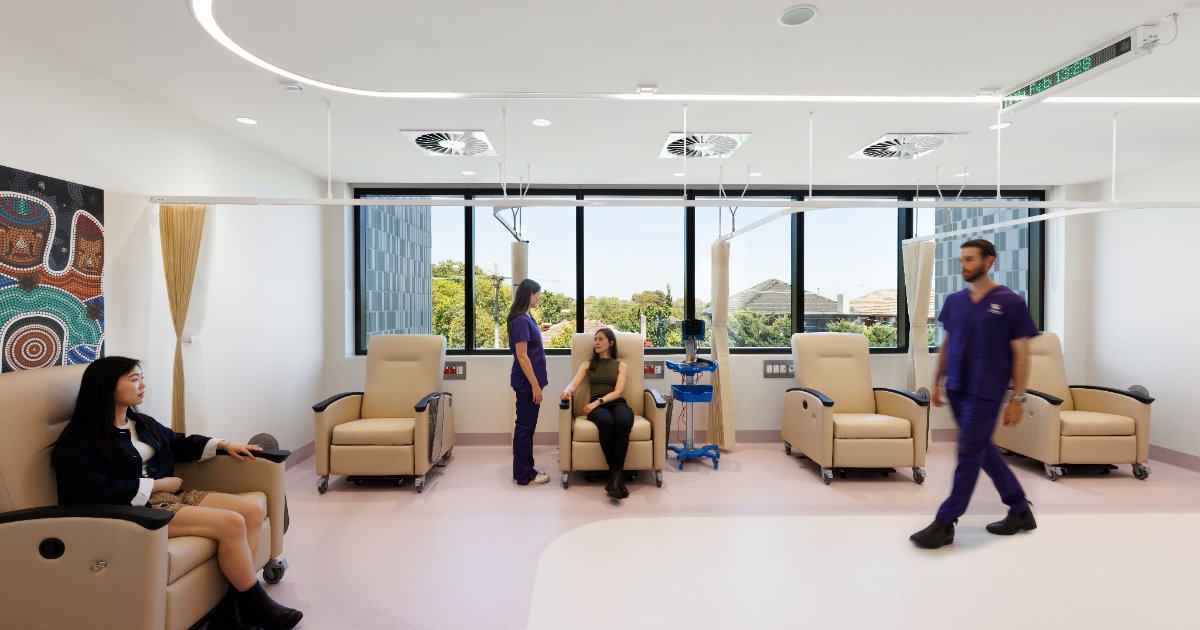
At Adeney Private Hospital, day oncology happens in our Medical Infusion Centre on Level 3, open Monday to Friday. Our guide to medical infusions explains the mechanics of an infusion step by step.
What a treatment day looks like
At Adeney, you check in at reception on the ground floor, then head up to the Medical Infusion Centre on Level 3. A nurse confirms your details, checks your blood pressure, pulse and temperature, and makes sure your blood test results and treatment orders are ready.
Appointment length depends on your treatment. Some take around one to two hours; others can take most of a day. Your oncologist or our nurses can tell you roughly how long to allow.
You’ll sit in a treatment chair with its own smart screen. From that screen you can order meals and snacks from the hospital menu whenever you feel like eating, which helps on days your appetite comes and goes. The centre sits on the top floor, with plenty of natural light and views across Melbourne. Bring a book, your phone or tablet and headphones. Wear something comfortable with sleeves that roll up easily, or a top that gives access to your port.
You’ll find more on what to bring and where to go on the day in our guide to preparing for your admission.
You’re welcome to bring one support person to each appointment. There’s onsite parking under the hospital, which is free for the first two hours.
Three questions to ask
Where will I have my treatment?
Medical oncologists in Melbourne usually treat patients at one or more hospitals. It’s reasonable to ask yours where they treat, and whether there’s a choice. A course of treatment can mean dozens of trips, so travel time, parking and the setting itself matter more than they would for a one-off procedure. If you’d like to be treated at Adeney, ask whether your oncologist is accredited here, or check our list of medical Oncologists and Haematologists.
Who will be with me?
Ask whether a support person can come, how many, and whether that changes on long days. Ask who to call between appointments, during business hours and after hours, and save those numbers in your phone before your first cycle.
What will it cost?
Cancer Council Australia encourages people to ask for the total cost of treatment and which other health professionals will be involved. Your doctor and hospital should give you informed financial consent, meaning a clear estimate in writing before you start. It’s also worth a call to your health fund to confirm your policy covers “chemotherapy, radiotherapy and immunotherapy for cancer”, which is one of the standard clinical categories in Australian hospital cover.
What it costs at Adeney
There are usually three separate pieces to the cost of cancer treatment: the hospital, your specialist and your medicines. Here’s how each one works at Adeney.
The hospital. Adeney offers zero out-of-pocket costs for eligible Medibank and Bupa members. For oncology, that covers your hospital fees when you’re admitted for treatment. You need eligible hospital cover and to have served any waiting periods. Some people may have a co-payment they need to make each time they are admitted to hospital. Your fund can confirm how it applies to your policy.
Your medicines. The medicines you have during treatment are usually covered as part of your admission, so you don’t pay for them separately. Some treatments include high-cost medicines. Your health fund might cover these in full, cover part of the cost, or not cover them at all, and if they don’t, you pay the difference. Whenever a high-cost medicine is prescribed, we get a quote from the pharmacy and check with your fund, so you’ll know before you start whether there’s a cost to you and how much it is. Some people also choose to pay for a medicine themselves. This can happen when a medicine is funded for some cancers but not for the one you have. If your oncologist raises this, ask for the cost in writing and whether there are other options.
Your specialist. Appointments with your medical oncologist or haematologist in their consulting rooms sit outside the hospital arrangement. Medicare pays a rebate for these visits. Ask your specialist’s rooms what each appointment costs.
Our zero out-of-pocket guide explains the full arrangement at Adeney Private Hospital, including what’s excluded.
Between treatments: when to call, and when to go to emergency
Some cancer treatments lower your body’s ability to fight infection, so a fever between cycles needs prompt attention.
Call for help if your temperature is 38°C or higher, or if you notice any of these:
- chills, especially shaking chills
- feeling feverish, hot or sweaty
- sores in or around your mouth or throat
- a cough or flu-like symptoms
- burning or pain when you pass urine
- loose or watery bowel motions
- constipation
- redness, swelling, ooze or tenderness anywhere on your body, Including around a Port or PICC or intravenous catheter site.
- unusual vaginal discharge
Monday to Friday, 7am to 4pm: call Adeney’s Medical Infusion Centre on 03 7049 5300, or your oncologist’s rooms.
After hours and on weekends, you can call our after-hours coordinator on 03 7049 5252 or go to your nearest emergency department and tell them you’re having cancer treatment. In an emergency, call 000.
How to start treatment at Adeney
You’ll need a referral from your GP to a medical oncologist. If you’d like to have treatment at Adeney, ask your GP to refer you to an oncologist who treats here, or ask your current oncologist whether Adeney is an option. Some of our oncologists and haematologists also consult in rooms on Level 3, inside the hospital. For questions before your first visit, call our Medical Infusion Centre on 03 7049 5300.
Frequently asked questions
How long does a day oncology appointment take?
It depends on your treatment. Some infusions take approximately an hour and others take several hours. Plan for time with the nurse before and after, and ask your oncologist or our nurses how long to allow.
Can someone come with me to chemotherapy at Adeney?
Yes. You can bring one support person to each appointment at our Medical Infusion Centre.
Can I eat during treatment?
Yes, you can eat and drink as you would normally. At Adeney, meals and snacks can be ordered from the hospital menu at any time using the smart screen at your chair.
Is chemotherapy at Adeney no gap?
For eligible Medibank and Bupa members, Adeney’s hospital fees for oncology treatment, including the medicines given during your admission, are zero out-of-pocket. You may still pay a policy excess, and some high-cost medicines may involve a cost, which we’ll confirm with you and your fund before you start. Specialist consultations in rooms are separate.
Do I need a referral?
Yes. Your GP refers you to a medical oncologist, who arranges your treatment at a hospital where they practice.
What should I do if I get a fever at night?
If your temperature is 38°C or higher, or you have signs of infection outside Adeney’s hours, go to your nearest emergency department and tell staff you’re having cancer treatment.
Where can I get more support?
Cancer Council’s 13 11 20 line offers information and support, including help with the financial side of treatment.
Important information
This article is general information only and isn’t a substitute for advice from your treating doctor. Costs depend on your health fund, your level of cover and your treatment. Your doctor and Adeney will give you informed financial consent before treatment.
Sources
- Cancer Council Australia. What will I have to pay for treatment? https://www.cancer.org.au/support-and-services/practical-and-financial-assistance/what-will-i-have-to-pay-for-treatment
- Australian Government, privatehealth.gov.au. Clinical categories. https://www.privatehealth.gov.au/health_insurance/howitworks/clinical_categories.htm
- Australian Government Department of Health. Out of pocket costs. https://www.health.gov.au/topics/private-health-insurance/what-private-health-insurance-covers/out-of-pocket-costs
- Cancer Institute NSW. Risk of infection. https://www.cancer.nsw.gov.au/about-cancer/types-of-cancer/uterine-cancer/treatment/side-effects/risk-of-infection
- Metro North Health (Queensland Health).
https://metronorth.health.qld.gov.au/hospitals-services/cancer-care-services/chemotherapy-medical-oncology-patients